
 Lisa Rubiano
As a transformational coach, I have learned a lot of skills that I teach my clients. Before I was a coach, I got coached. It was based on a different program than the one I decided to train in. There are similarities but there had been something nagging me about applying what I learned to helping people. I think a misconception I had in coaching is thinking that our work is only thought work. We were taught the Karpman Drama Triangle: a dysfunctional dynamic in which people move between three roles: Victim, Persecutor, and Rescuer. The Victim feels powerless, the Persecutor is seen as the source of the problem, and the Rescuer steps in to fix or save the Victim, often reinforcing the cycle rather than changing it. I thought of this often as I thought about my work with women physicians who are suffering in the systems of medicine. I think a better word than system may be medical culture.
In the Drama Triangle, I could easily map what I was seeing: medical culture as the Persecutor, the physician as the Victim, and any number of people or interventions stepping into the Rescuer role. In coaching we use David Emerald’s The Empowerment Dynamic to adjust the roles. The persecutor becomes the challenger, the physician becomes the creator and the rescuer becomes the coach.
Our role as coaches is to help people look at their thoughts so they become the Creator. To determine how they want to respond to the Challenger. What I see online with some coaches is that this neglects the challenger.
The challenger just doesn’t disappear simply because the physician becomes a Creator.
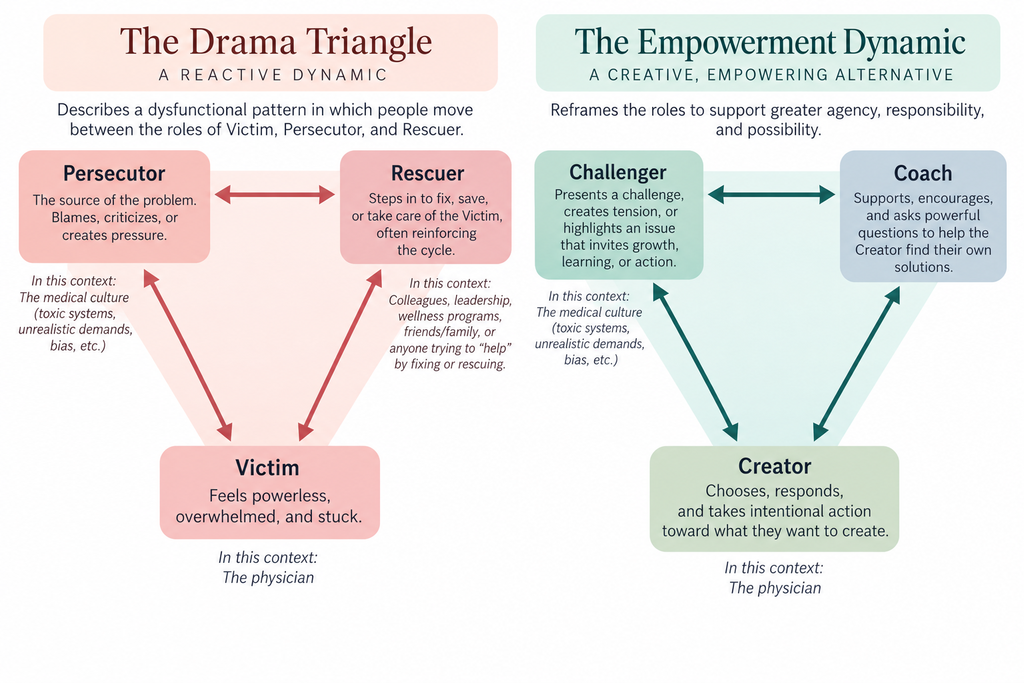
The thing is- the coach can’t coach the challenger. That isn’t our role. Especially in this situation because we are talking about an enormous vague entity called medical culture. There is a role for that but is advocacy, not coaching.
If you follow me on LinkedIn where I have been posting for the year and a half or so, I have written often about how the system is broken and you aren’t. I talk about how the resilience is harmful because it places all the onus on us as the solution to a broken system.
So let me tell you how I think about coaching
My beliefs:
The system is broken. What the works has become is a major contribution to burnout.
As well as moral injury.
Women physicians experience gender bias.
Physicians experience racial bias.
Most employers do not care about you as a person, first. They are a business and their priorities don’t focus on you thriving as a human.
I don’t believe that we are having a crisis of resilience, lazy doctors, or as I saw recently online, clinical marshmallows.
Nearly 42% of physicians report symptoms of burnout. For women physicians, it’s 46%.)
Women physicians are leaving clinical medicine at 48-49 years old.
A doctor dies by suicide nearly every day.
We cannot look at numbers like these and seriously pretend that every physician is independently having the wrong thoughts or has a resilience problem.
So, if the systems, the culture isn’t addressing it’s problems,does that mean there is nothing you can do?
No!
Does it mean that you have no personal accouontabilty?
Also no.
And that doesn’t mean I am blaming you either.
But let’s start with the elephant in the room: the system.
Sometimes, you really do just need to change your situation.
I recently heard Dr. Angela Duckworth on The Happiness Lab podcast talking about her new book called Situated. She is best known for her work on grit and now is looking beyond what happens inside the individual. Essentially, she says that everything around you influences you as much as your thinking about it does. Our situation includes the people around us, the places we’re in, and the norms and values of the cultures we’re part of. Basically, the situation matters.
She talks about something called situational agency: changing your circumstances isn’t the opposite of taking personal responsibility. Changing your circumstances can be an expression of agency.
In medicine, I have called the toxic culture, the water we swim in. Interestingly, they use almost the exact same metaphor in the podcast. We often don’t even notice the water we’re swimming in or how it is affecting us.
Part of our water is our moralization of our own suffering, grit and will power. Thinking we can, and should, be able to do anything, such as not need sleep. Or not miss anything even though your day is constantly rushed because your appointments are 15 minutes.
So the solutions proposed are to be more efficient. More resilient. To think better thoughts about your situation.
From the business’s perspective-this works great. The doctors have to work on themselves, and they can continue to create workplaces, schedules, and metrics that serve them unilaterally.
To be clear, becoming more efficient can help. Changing how we think can help. I teach many of these skills myself.
But they aren’t the whole story.
This fails to include our situations or our circumstance as part of the solution.
When we’re in a situation that isn’t bringing out our best, or allowing us to be fully human, changing the situation can be part of the solution.
If the job is toxic, you may just need to quit.
If it isn’t, you may need to adjust the dose,
The frequency.
The expectations.
The boundaries.
The role medicine plays in your life.
In every circumstance, what you have is agency, The power to decide what to do with it.
Can it be scary? Yes.
Do you have 1,000 reasons you might not be able to change something? Also yes.
Can you and have you done hard shit before? 1,000,000 x yes.
Listen, I don’t know you or your specific situation. But if you are reading this, I believe in your capacity to decide what you need, and in your ability to change what you’re willing and able to change.
If you’re wondering what that is, your thoughts, your circumstances, or some combination of both, that’s work we can do together. You can book a call with me here.
